
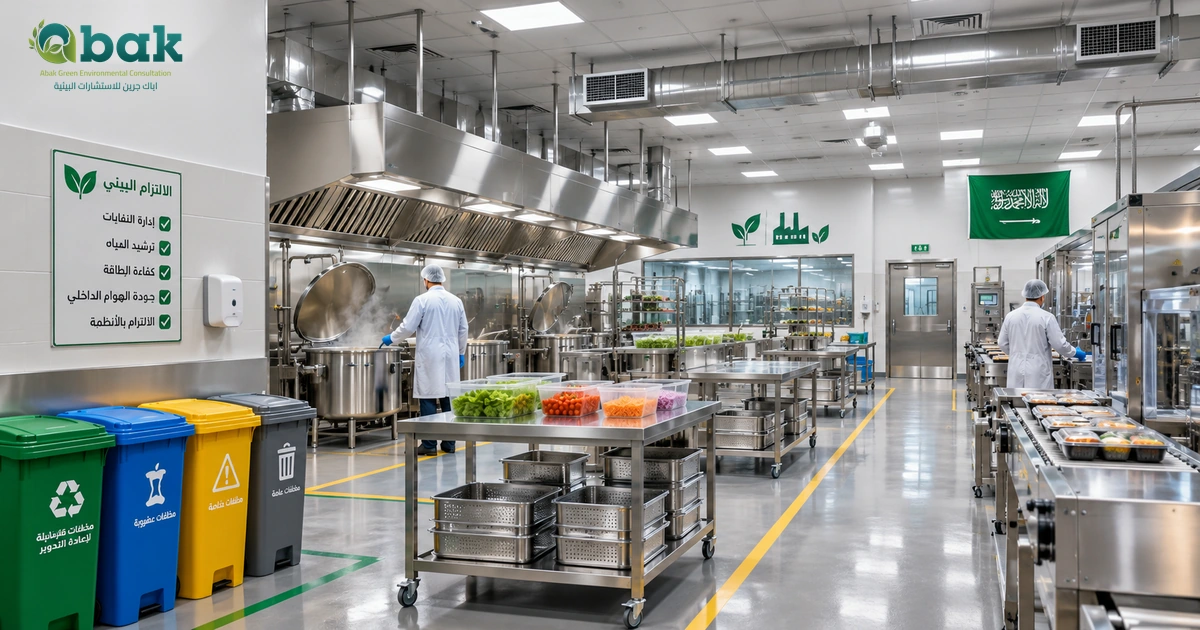
Environmental requirements for central kitchens are more extensive than those for a single restaurant because a central kitchen produces food for multiple branches: larger quantities of oils, grease, organic waste, and wastewater, along with more cooking and refrigeration equipment. This guide explains what is required and what additional requirements apply when the operation becomes a food factory.
The food sector is broad, ranging from a small restaurant in a residential neighborhood to a central kitchen serving many branches or a food factory in an industrial city. The first question owners ask is: Do I need an environmental permit for my restaurant?
Size and Activity Determine the Answer
The Executive Regulations for Environmental Permits classify activities by their type, size, energy use, resource consumption, and surrounding receptors. Requirements therefore differ between a small restaurant, a central kitchen, and a factory. The National Center for Environmental Compliance makes the decision after reviewing the classification form. The general rule is that as production volume, equipment, and waste increase, the activity is more likely to require a permit and face more extensive requirements.
The Permitting Process for Central Kitchens and Food Factories
- Activity classification: A classification form with details on production capacity, equipment, fuel, water, and location. The published processing time is 10 business days, and the fee is SAR 500.
- Construction permit before construction or fit-out, depending on the category assigned by the Center: an environmental management plan for Category I or an environmental impact assessment for Category II.
- Operating permit before production begins.
- Permit amendment before any expansion or new production line. Read Environmental Permit Amendments.
Converting an existing restaurant into a central kitchen serving multiple branches changes the scale and nature of the activity. Its environmental status should therefore be reviewed before the conversion, not afterward.
Key Environmental Aspects of Food Operations
- Oils and grease: Used frying oil must not be discharged into sewers; it must be collected and handed over to a licensed entity. Grease traps in the drainage system require regular cleaning and recordkeeping.
- Organic waste: Food scraps and spoiled raw materials, generated in large quantities by central kitchens and factories.
- Water: High water consumption for washing and cleaning, and the discharge of wastewater containing fats and detergents.
- Emissions and odors: Exhaust systems, ovens, and their stacks, particularly near residential areas.
- Refrigerants: Maintenance of refrigeration systems in cold storage warehouses.
Central Kitchens and Food Factories
These operations are closer to industrial activities than to restaurants: high production volumes, multiple types of equipment, and larger quantities of waste. They are therefore usually subject to more clearly defined requirements and need an environmental management plan covering waste, water, and emissions, along with regularly maintained records.
Detailed Environmental Requirements for Central Kitchens
| Aspect | Requirements | Supporting Documentation in the File |
|---|---|---|
| Grease in wastewater | A grease trap with capacity suited to production volume, and regular cleaning | Records of cleaning and quantities removed |
| Used cooking oil | Separate collection and handover to a licensed entity; no discharge or sale to unlicensed parties | Handover documents |
| Organic waste | Separation from packaging, closed containers, and regular collection by a licensed service provider | Contract and transport documents |
| Packaging and cardboard | Sorting for recycling | Handover documents |
| Refrigeration and freezing | Maintenance to prevent gas leaks; ozone-depleting substances are subject to phaseout plans under Article 9 of the Environment Law | Maintenance and recharge records |
| Exhaust extraction and odors | Filters for exhaust hoods and their maintenance, particularly near residential areas | Filter replacement records |
| Boilers and large ovens | Their stacks are stationary sources subject to the requirements of the Air Quality Regulations | Results of required measurements |
Under the Waste Management Law, anyone who hands waste or oils over to an unlicensed person becomes jointly and severally liable with that person for damages. Read Used Oil Management and Licensed Carriers.
Choosing a Central Kitchen Location
The location determines half of the environmental requirements before any equipment is purchased. Questions to ask before signing:
- What surrounds the site? A kitchen near a residential neighborhood faces complaints about odors, noise, and truck traffic. An industrial or commercial area is more suitable.
- Can the sewer system handle the discharge? A central kitchen discharges much larger volumes of wastewater than a restaurant.
- Where will supply and waste collection trucks park? A separate loading area prevents containers from accumulating in the street.
- Was the site previously used for a polluting activity? Read Environmental Site Assessment Before Leasing.
When an odor complaint is received, the solution often involves maintaining exhaust filters, scheduling intensive cooking periods, and collecting organic waste regularly. Read Environmental Complaints from Neighbors.
Additional Requirements When the Operation Becomes a Food Factory
- Industrial wastewater: Higher organic loads and fat content may require pretreatment before discharge. Read Industrial Wastewater Treatment Before Discharge.
- Stack measurements: Annual measurements for each stack not subject to continuous monitoring, with initial measurements within 120 days of construction or 40 days of reaching target production, whichever comes first.
- Cold storage warehouses: Larger refrigeration systems and backup generators. Read Refrigerated Food Warehouses.
- Monitoring reports in accordance with permit requirements, prepared through a licensed service provider.
Examples
- A central kitchen for a restaurant chain: Grease, oils, and organic waste are its main environmental issues, along with exhaust extraction and odors if it is near a residential neighborhood.
- An industrial bakery: Ovens and their stacks, and large volumes of packaging.
- A dairy or juice factory: Large quantities of washing and sanitizing water, and wastewater with a high organic load.
- A catering kitchen for large projects: Variable production volumes, requiring planning for maximum capacity rather than average output.
Common Mistakes
- A restaurant-sized grease trap for a kitchen producing food for ten branches.
- Selling used oil to any buyer without verifying their license.
- Mixing organic waste with packaging, making both difficult to recycle.
- Expanding without amending the permit when adding branches or production lines.
Central Kitchen Checklist
- The permit is valid and matches current production capacity.
- The grease trap is suited to production volume, and its cleaning records are up to date.
- Used oil goes to a licensed entity, and its documentation is retained.
- Organic waste is separated, and the collection contract is valid.
- Maintenance records for refrigeration systems and exhaust filters are up to date.
- No oils or waste are discharged into the sewer system.
Practical Tips
- Contract with a licensed entity to collect used oil, and retain handover receipts.
- Set a grease trap cleaning schedule and record every cleaning.
- Separate organic waste from other waste to facilitate transport and treatment.
- When opening a new branch or converting a restaurant into a central kitchen, review your environmental status before operating, as a change in the scale of the activity may require a new permit.
Frequently Asked Questions
Does a central kitchen need an environmental permit?
The National Center for Environmental Compliance determines this from the classification form based on production volume, equipment, and location. Construction and operating permits are then required according to the assigned category.
What are the main environmental requirements for central kitchens?
An appropriately sized grease trap and cleaning records, handover of used oil and organic waste to licensed entities, and maintenance of refrigeration systems and exhaust filters.
What should I do with used cooking oil?
Collect it separately and hand it over to a licensed entity with a handover document. It must not be discharged into the sewer system or sold to an unlicensed person.
Does converting a restaurant into a central kitchen require a new permit?
It changes the scale and nature of the activity, so its environmental status should be reviewed before conversion. A permit or an amendment to the existing permit may be required.
Do food factory boilers require measurements?
Their stacks are stationary sources and must be measured annually if they are not subject to continuous monitoring, with initial measurements after construction in accordance with the Air Quality Regulations.
Who collects organic waste from a central kitchen?
A service provider licensed by the National Center for Waste Management, with a contract and a transport document for each collection.
How do restaurant requirements differ from central kitchen requirements?
A central kitchen produces food for multiple branches, generating larger quantities of grease, oils, waste, and wastewater and using more equipment. Its requirements are therefore more extensive. For restaurants, read Environmental Requirements for Restaurants and Food Factories.
Are refrigeration systems subject to environmental requirements?
Yes. Maintenance prevents gas leaks, and ozone-depleting substances are subject to phaseout plans under Article 9 of the Environment Law.
How Abac Green Can Help
We review your activity and its scale to determine whether it requires an environmental permit, and prepare the application file, environmental management plan, and appropriate records for restaurants, central kitchens, and food factories. Request a review of your operation.