
A dental clinic, a medical complex, or a diagnostic laboratory: all generate medical waste that requires handling entirely different from ordinary waste. Responsibility begins with the facility itself, not the transporter.
Medical waste from hospitals and clinics, also known as healthcare waste, is among the most hazardous types of waste: it can transmit infections, cause sharps injuries, or contaminate the environment with chemicals and pharmaceuticals. The National Center for Waste Management (MWAN) therefore classifies the collection and transportation of hazardous healthcare waste and its treatment as activities requiring a specific license.
Managing this waste in a hospital or medical complex is not solely the responsibility of cleaning staff. It is a system that begins at the patient's bedside and ends with a receipt issued by a licensed treatment provider.
Regulatory Framework
Saudi Arabia's waste sector operates under the Waste Management Law, issued by Royal Decree No. (M/3), dated 5/1/1443 AH, and its Implementing Regulations. The National Center for Waste Management (MWAN) regulates the sector, including medical and hazardous waste. Under MWAN's collection and transportation requirements, medical waste collection and transportation is a subactivity of hazardous waste management that may only be carried out by a licensed operator. Transporters may not deliver hazardous waste to an unlicensed facility.
The Healthcare Facility's Responsibility in 4 Stages
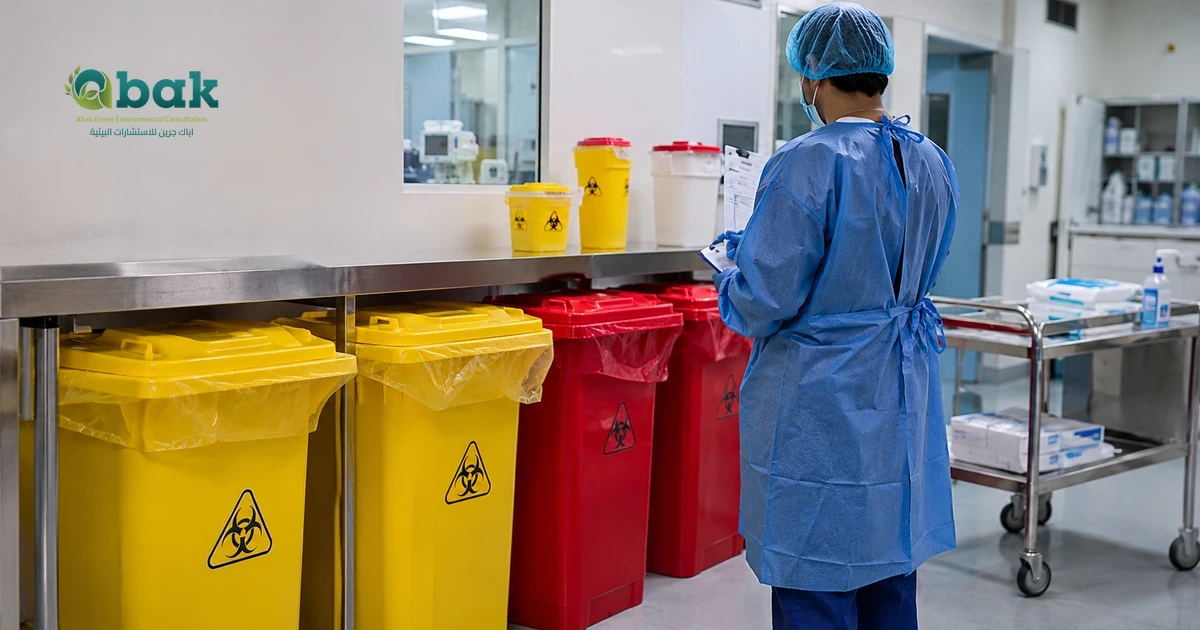
- Segregation at source: Separate medical waste from general waste where it is generated, and place sharps in puncture-resistant containers.
- Packaging and identification: Use designated bags and containers that are clearly identified according to waste type.
- Temporary storage: Keep waste in a designated, secure, enclosed area away from patient and food areas until collection.
- Handover and documentation: Contract with a MWAN-licensed transporter and retain documentation for every handover.
Recurring Mistakes in Small Clinics
- Mixing medical waste with general waste to reduce costs.
- Contracting with a transporter without verifying its license.
- Failing to maintain a record of waste quantities and collection dates.
- Using a temporary storage area that is open or shared with a materials storeroom.
What About the Environmental Permit?
Medical complexes and hospitals are service-sector operations with an environmental impact. The National Center for Environmental Compliance determines their requirements according to their size and nature after reviewing the classification form. Medical waste management is an essential part of the facility's environmental management plan and records in both cases.
Types of Medical Waste
| Type | Examples | Hazard Level |
|---|---|---|
| General waste (nonhazardous) | Paper, packaging, and food scraps | Low; handled as ordinary waste |
| Infectious waste | Contaminated dressings, used gloves, and laboratory cultures | High: infection risk |
| Sharps | Needles, scalpels, and broken glass | High: injuries and infection |
| Pathological waste | Human tissues and organs | High |
| Pharmaceutical waste | Expired or partially used medications | Moderate to high |
| Chemical waste | Disinfectants, laboratory materials, and solvents | Depends on the substance |
| Radioactive waste | Waste from nuclear medicine and radiation therapy | Outside MWAN's scope; regulated by a separate authority |
Most waste generated by a healthcare facility is actually nonhazardous. However, mixing it with infectious waste turns all of it into hazardous waste and multiplies treatment costs. This is why segregation at source is the most important step.
Medical Waste in Hospitals: The Management Chain in 6 Stages
1. Segregation at Source Separate waste directly where it is generated, using designated bags and containers for each type, with puncture-resistant containers for sharps .
2. Packaging and Labeling Do not fill bags and containers beyond three-quarters of their capacity. Seal them securely and label them with the waste type, source, and date.
3. Internal Transportation Use dedicated, enclosed carts along routes and at times that minimize contact with patients and visitors.
4. Temporary Storage Store waste in a designated, secure, tightly enclosed room that is easy to clean and located away from food and patient areas, while complying with the permitted storage duration .
5. External Transportation Use a provider licensed by MWAN for the activity of “collection and transportation of hazardous healthcare waste,” with a transport manifest. MWAN has launched an electronic transport manifest system to track waste.
6. Treatment and Disposal Use a provider licensed by MWAN for the activity of “treatment of hazardous healthcare waste,” using methods such as incineration, steam sterilization, microwave disinfection, or chemical disinfection.
Can Medical Waste Be Treated Inside a Hospital?
Yes. MWAN licenses an activity called “treatment of hazardous healthcare waste within healthcare facilities.” This requires:
- A license from MWAN for this activity.
- Ministry of Health approval for allocating the site within the healthcare facility.
Regulatory Obligations of Healthcare Facilities
| Obligation | Reference |
|---|---|
| Contracting with MWAN-licensed transporters and treatment providers | Waste Management Law (M/3, dated 5/1/1443 AH) |
| Complying with provisions governing waste management plans and contracting for waste management services | Schedule of Violations of the Waste Management Law |
| The facility's environmental permit and its conditions | Environment Law and Implementing Regulations for Permits |
| Ministry of Health requirements for healthcare waste |
A reminder: the Schedule of Violations of the Waste Management Law includes 97 violations, with specific categories covering contracting for waste management services and waste management plans. This means that contracting with an unlicensed transporter is a violation by the facility itself, not just the transporter.
What Does a Medical Waste Management Plan Include?
- An inventory of waste types, quantities, and sources in each department.
- Segregation, packaging, and labeling procedures for each waste type.
- Internal transportation routes and schedules.
- Specifications for the temporary storage room and the storage duration.
- Details of licensed transportation and treatment providers and their contracts.
- Records, transport manifests, and receipts.
- Emergency procedures for spills and needlestick injuries.
- Staff training and responsibilities.
Common Mistakes in Medical Waste Management
- Mixing general waste with infectious waste, increasing treatment costs.
- Filling sharps containers to capacity.
- Using an unsecured storage room or one close to patient areas.
- Failing to retain transport manifests and receipts.
- Failing to train new staff.
Frequently Asked Questions About Medical Waste Management
What are the types of medical waste?
General waste, infectious waste, sharps, pathological waste, pharmaceutical waste, chemical waste, and radioactive waste.
Who is authorized to transport medical waste in Saudi Arabia?
A provider licensed by the National Center for Waste Management (MWAN) for the collection and transportation of hazardous healthcare waste.
Can medical waste be treated inside a hospital?
Yes, with a MWAN license, Ministry of Health approval for the site, and an environmental permit.
Why is segregation at source important?
Because mixing general waste with infectious waste turns all of it into hazardous waste and increases treatment costs.
Is the facility responsible if the transporter is unlicensed?
Yes. Violations related to contracting for waste management services are included in the law's schedule of violations.
What methods are used to treat medical waste?
Incineration, steam sterilization, microwave disinfection, and chemical disinfection.
Official Sources
- Technical Requirements for MWAN Licenses: Healthcare Waste Activities (Istitlaa Platform)
- Violation Classification Schedule: MWAN
- Waste Management Law: MWAN
How Abak Green Can Help
We prepare a waste management plan for your healthcare facility, develop records and documentation forms, review its environmental status and permit requirements, and train responsible personnel on implementation. Contact us about your healthcare facility.
We prepare a medical waste management plan and its records for your hospital or medical complex, train your team to implement it, and verify the licenses of transportation and treatment providers. We also align the plan with the facility's environmental permit. Transportation and treatment themselves are carried out by MWAN-licensed providers.
Hazardous and Medical Waste Management · Healthcare Facilities · National Center for Waste Management (MWAN) · Request a waste management assessment for your facility